

How long does it take to build an app? Stages and store timelines
Timelines depend on scope, design, integrations, platforms and testing, plus Apple and Google review. Here is what each stage involves and what slows it.

How long does it take to build an app? It depends on the scope of the first version, the design, the integrations with other systems, whether you ship on iOS, Android or both, and testing. On top of that comes Apple and Google review, which on Google Play can include a mandatory testing period.
What are the stages of building an app?
Almost every project goes through these stages, although how long each one takes varies from app to app:
| Stage | What happens | What slows it down |
|---|---|---|
| Discovery and scope | Defines the problem, users and first-version features | Open decisions or too many stakeholders |
| UX/UI design | Screens and flows get designed and approved | Rounds of revisions, slow sign-off |
| Development | The app, backend and admin panel get built | More features, complex rules, two platforms |
| Integrations | Payments, ERP, CRM, maps or other services get connected | Access requests or thin documentation |
| Testing | Tested on real devices and with users | Deep bugs or store testing requirements |
| Release | Listings get prepared and the app goes through store review | Accounts not set up or extended reviews |
| Maintenance | Bugs get fixed and new versions ship | Ongoing while the app is live |
How does scope affect the timeline?
Scope moves the calendar more than anything else, and it's also the factor you control most. Every screen, every user type and every business rule adds design, development and testing. An ordering app with a catalog, a cart and order tracking won't take as long as one that also has coupons, a loyalty program, several delivery methods and a reporting dashboard. That's why it pays to launch an MVP (minimum viable product) first: a version with only what's needed to solve the main problem, with everything else saved for later releases. Besides shipping sooner, you learn from real users which features actually matter. What stretches a project usually isn't the original feature list but changes midstream. A new feature that shows up once development is well underway can force you to rework screens and tests. Rank each feature as must-have, important or later, and agree with your development partner on how changes get approved and how they affect the date.
How much time does design add?
Design isn't just about making the app look good. It's deciding how users move from one screen to the next, what happens when something fails and how every state looks: empty, loading, error. This stage saves time later, because building on approved screens avoids rework. What stretches it isn't so much the number of screens as the rounds of feedback. If several people at your company need to approve each proposal, or their comments arrive days apart, the schedule slips even when the design team is ready to go. To avoid that, name one person who makes the final call and gathers everyone else's feedback before sending it over. It also helps a lot to show up with your brand guidelines, logos, copy and examples of apps you like. If the app should feel natural on each platform, design also has to account for Apple's and Google's guidelines, which can mean extra adjustments when you're designing for both iOS and Android.
Why do integrations make a project take longer?
An integration depends on someone else. Connecting your app to a payment gateway, an ERP, a CRM, a mapping service or a delivery platform means requesting access, getting test credentials, reading the other system's documentation and working within its rules. If that system is modern and well documented, the work is predictable. If it's an older internal system with no documentation, or a vendor that's slow to reply, the integration can become the slowest part of the project even when the app itself is ready. Some services, especially payment providers, also need to verify your business account before they allow live charges. To keep development moving, list every system the app needs to connect to in the very first meeting, figure out who grants access to each one and request those credentials before coding starts. If an integration looks uncertain, ask your team to test it at the beginning of the project rather than leaving it for the end.
Does building for iOS and Android take longer?
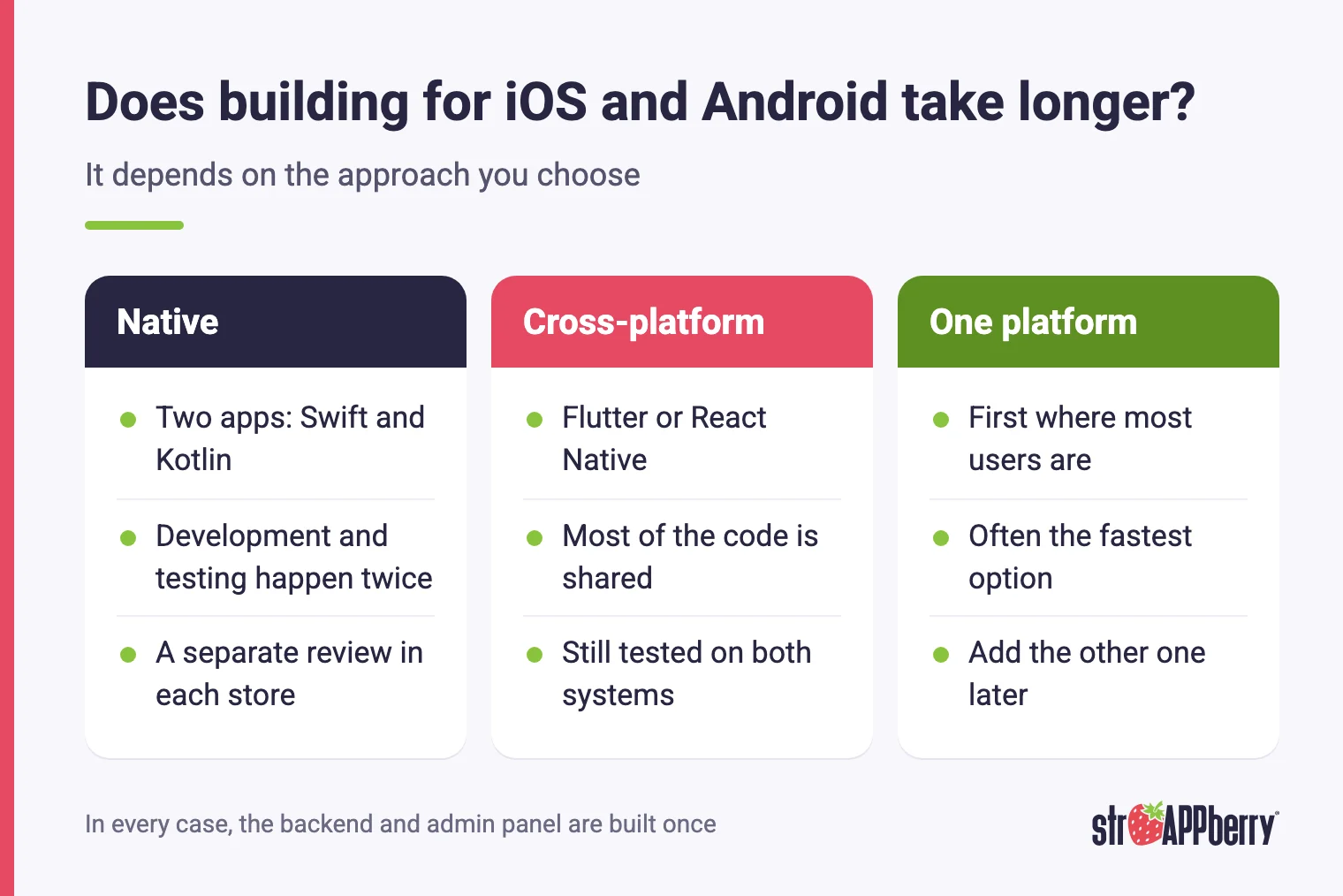
It usually takes longer than building for one platform, but how much longer depends on the approach. With native development you build two apps with different tools, Swift for iPhone and Kotlin for Android, so a good share of the development and testing work happens twice. With a cross-platform approach like Flutter or React Native, most of the code is shared, which cuts duplicated work, although you still test on both systems and publish separately to each store, each with its own review. There's a third option that's often the fastest: launch first on the platform most of your users are on, then add the other one. If your field team carries Android phones, starting with Android can bring forward the day the app starts paying off. Whatever you choose, the backend and admin panel only get built once and serve both apps, so that part of the timeline doesn't double when you add a second platform.
How long does testing take before launch?
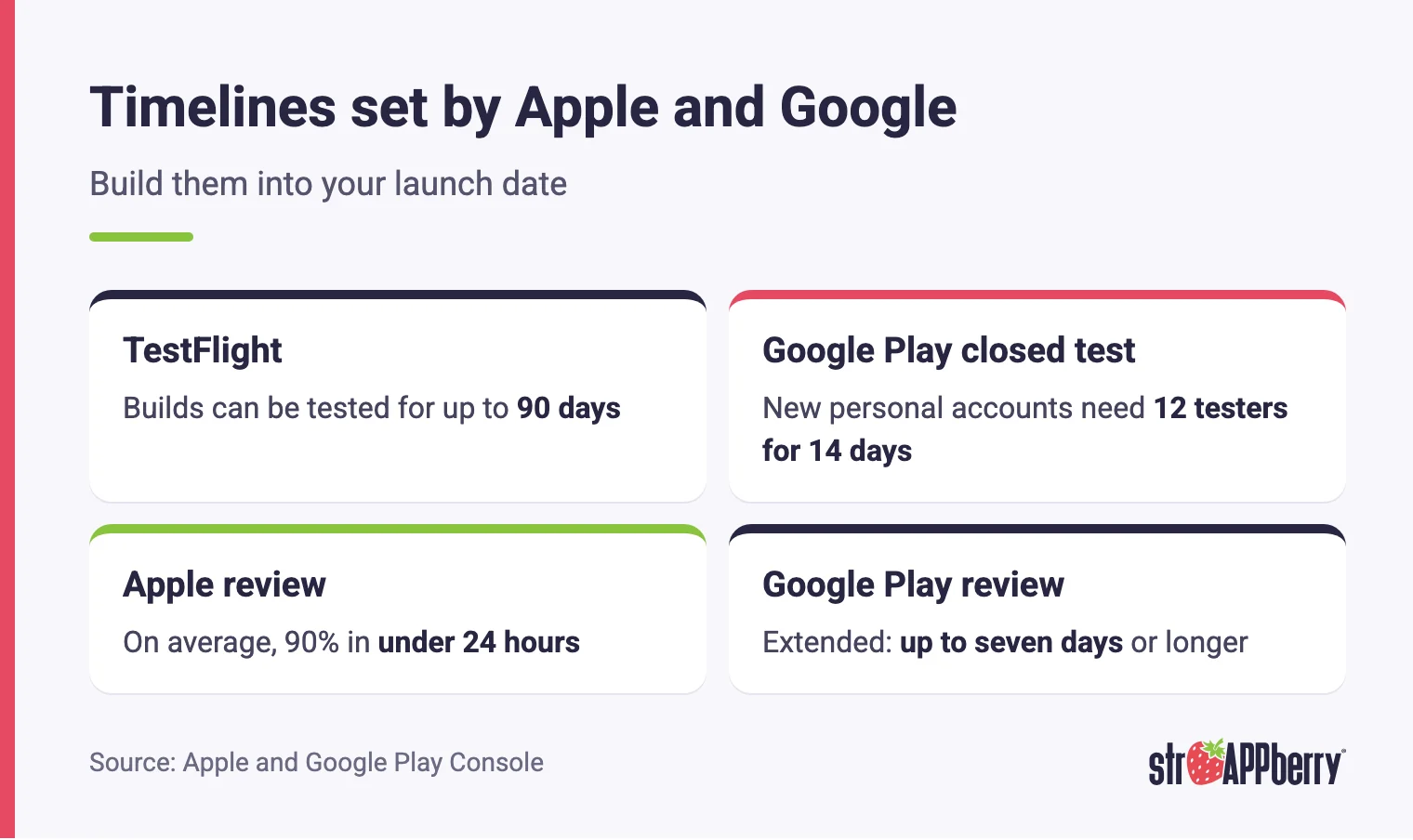
Some testing is up to you, and some is set by the stores. Your part includes checking the app on real phones with different screen sizes and OS versions, and putting it in front of a group of users before launch. On iPhone that happens through TestFlight: Apple allows up to 100 internal testers and up to 10,000 external testers, each build can be tested for up to 90 days, and the first build you share with external testers goes through App Review. Google Play has a requirement worth knowing from day one: personal developer accounts created after November 13, 2023 must run a closed test with at least 12 testers who stay opted in for 14 days in a row before they can publish to production. That rule applies to personal accounts. If the app will be published under your company's name, the organization account requires a D-U-N-S number, so start that paperwork weeks before development wraps up.
How long do Apple and Google take to review an app?
Each store reviews the app before it goes live, and every update after that. Apple says that on average 90% of submissions are reviewed in less than 24 hours, and it lets you request an expedited review to fix a critical bug or when the app is tied to an upcoming event. Google Play says certain apps and accounts go through extended reviews that can take up to seven days, or longer in exceptional cases. Those clocks start when you submit, and if the app is rejected, you fix it and wait again. The most common rejections, covered in our guide on how to publish an app on the App Store and Google Play, can be avoided during development: Apple asks for a finished app with no placeholder text and a demo account if the app has a login. It also helps to have the store listing ready, with the description, screenshots and the disclosure of what data the app collects. Build review time into your launch date, and hold off on announcing it publicly until the app is approved in both stores.
What can you do to launch sooner?
- Define the MVP scope and separate what can wait for a second release.
- Name one person at your company who approves designs and answers questions every week.
- Hand over access to every system the app connects to at the start.
- Set up the Apple Developer Program and Google Play accounts in your company's name, with its D-U-N-S number, before development ends.
- Prepare copy, images and privacy details for the store listings.
- Consider launching on one platform first if most of your users are there.
- Leave room in the schedule for each store's review.
At Strappberry we build the MVP in 2 months. Larger projects with more modules ship in phases with weekly progress updates, so you can start using parts of the system before everything is finished, and we test with real users before publishing to the stores. Explore our custom software development services or tell us about your project to map out your timeline.
Sources
- Apple: App Review
- App Store Connect: TestFlight overview
- Play Console Help: publish your app
- Play Console Help: app testing requirements for new personal developer accounts
- Play Console Help: required information to create a developer account
- Apple Developer Program: enrollment
- App Store Review Guidelines
Related articles

App store publishing
How to publish an app on the App Store and Google Play: requirements and steps
You need a developer account for each store, privacy details, testing with real users and an approved review. Here are the steps.
· Equipo Strappberry