

App development cost in Mexico: what drives the price of an app
An app's cost depends on scope, platforms, integrations and maintenance. Here is how each factor works so you can get quotes you can compare.

There's no single figure for app development cost in Mexico. The price depends on how many features the first version needs, whether it ships on iOS, Android or both, which systems it connects to, and who maintains it after launch. Pin down those four points before asking for quotes, so you can compare them side by side.
What drives the cost of building an app?
An app's price is mostly the time of the team that designs, builds, tests and publishes it, so anything that adds work moves the budget. The heaviest factors are usually the number of screens and flows (sign-up, catalog, cart, profile, admin dashboard), how complex your business rules are, the integrations with other systems, and how many platforms the app will run on. Design matters too, because an interface built around your brand takes more hours than one assembled from standard components. So does testing, which grows with every device type you need to support. Two apps that look alike can cost very different amounts if one of them has to work offline, take payments or sync with an ERP. That's why a serious quote starts with questions about how your business operates, not with a flat rate.
The factors worth reviewing first are:
- the scope of the first version;
- the platforms: iOS, Android or both;
- the backend and admin dashboard;
- integrations: payments, CRM, ERP, delivery or maps;
- user experience and interface design;
- testing and app store submission;
- maintenance after launch.
How much does the scope of the first version matter?
It's the factor you control the most. Asking for every feature from day one is the fastest way to overspend and stretch the development timeline. The alternative is an MVP (minimum viable product): a first version with only what's essential to solve your users' main problem. An ordering app, for example, can launch with a catalog, a cart and order tracking, and leave coupons, a loyalty program or recommendations for a second phase. Once real users have the MVP, you learn which features they actually use before investing in the rest, and the budget for the next release is based on data instead of guesses. To get an MVP quote, list your features and tag each one as "must have", "important" or "can wait". Then ask vendors to price the list with those tags in mind.
Does building for iOS and Android at the same time cost more?
It depends on the approach. Native development means building two apps: one for iPhone, usually in Swift, and one for Android, where Google recommends Kotlin. That's two codebases to build, test and maintain, which usually raises the cost, although each app gets the most out of its platform. With a cross-platform approach such as Flutter or React Native, most of the code is shared between both versions. That cuts duplicated work when the app revolves around forms, catalogs, bookings or lookups in your system, but it may still need native code for very device-specific features. To choose between a native or cross-platform app, look at where your users are and how much each phone feature matters to the product. For a closer look by platform, see how we handle iOS app development for businesses and Android app development for businesses.
What costs come on top of development?
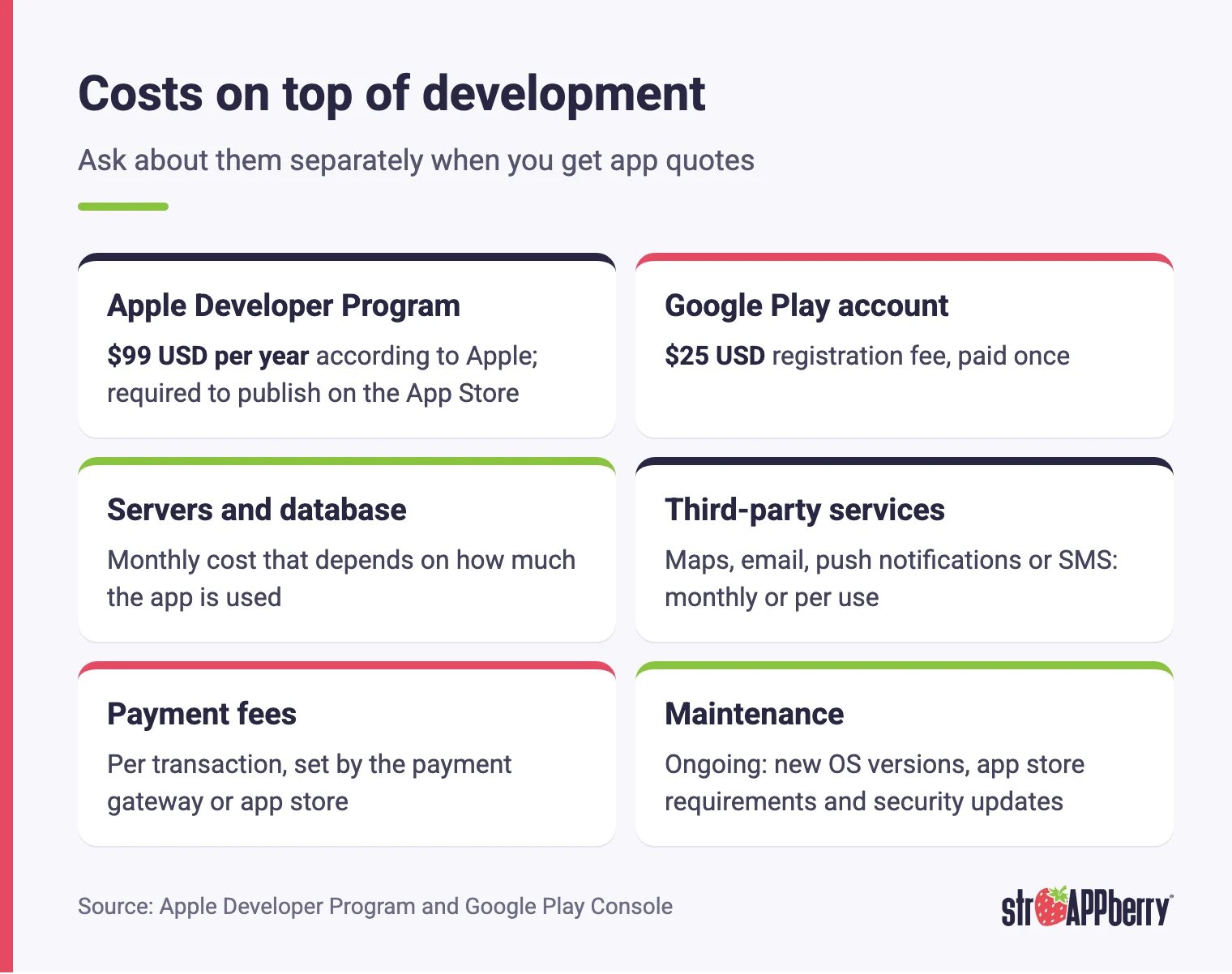
A development quote doesn't always cover what it takes to keep the app running. Ask about these separately:
| Item | Who charges it | How often | Reference |
|---|---|---|---|
| Apple Developer Program, required to publish on the App Store | Apple | Yearly | $99 USD per year according to Apple; pricing may vary by region |
| Google Play developer account | One-time | $25 USD registration fee | |
| Servers and database | Your cloud or hosting provider | Monthly | Depends on how much the app is used |
| Third-party services: maps, email, push notifications or SMS | Each provider | Monthly or per use | Varies by provider and volume |
| Payment fees | The payment gateway or app store | Per transaction | Depends on the provider and what you sell |
| Maintenance and updates | Your team or your development partner | Ongoing | See the next section |
Payment fees deserve attention during design. In most cases, Apple requires its in-app purchase system to unlock digital features or content (in the US storefront, apps can also link to their own website for purchases), while physical goods and services used outside the app, like a food order, must be paid through other methods. Google Play has an equivalent rule for its billing system, with exceptions for alternative billing programs in eligible countries. Knowing which side your business model falls on changes both your operating costs and the integration work.
Why should maintenance be part of the budget?
An app isn't finished the day it goes live. Apple and Google ship new versions of their operating systems every year, and the stores keep updating their requirements for publishing an app. Google, for instance, requires new apps and updates to target a recent Android version, and that minimum rises every year; an app that falls behind stops being available to new users on recent versions of the system. New rules also appear over time: today both Apple and Google require that if an app lets people create an account, it must also let them delete it. Add to that the security updates for the libraries the app depends on and changes in the services it integrates with, such as payment gateways or maps. Setting aside a maintenance budget from the start keeps the app from breaking right when it has the most users.
How do you get quotes you can actually compare?
Send every vendor the same information and the proposals will line up. Include:
- the problem you want to solve and who will use the app;
- your feature list, tagged as must have, important or later;
- the platforms: iOS, Android, web or a mix;
- the systems the app needs to connect to;
- any existing designs, code or previous app.
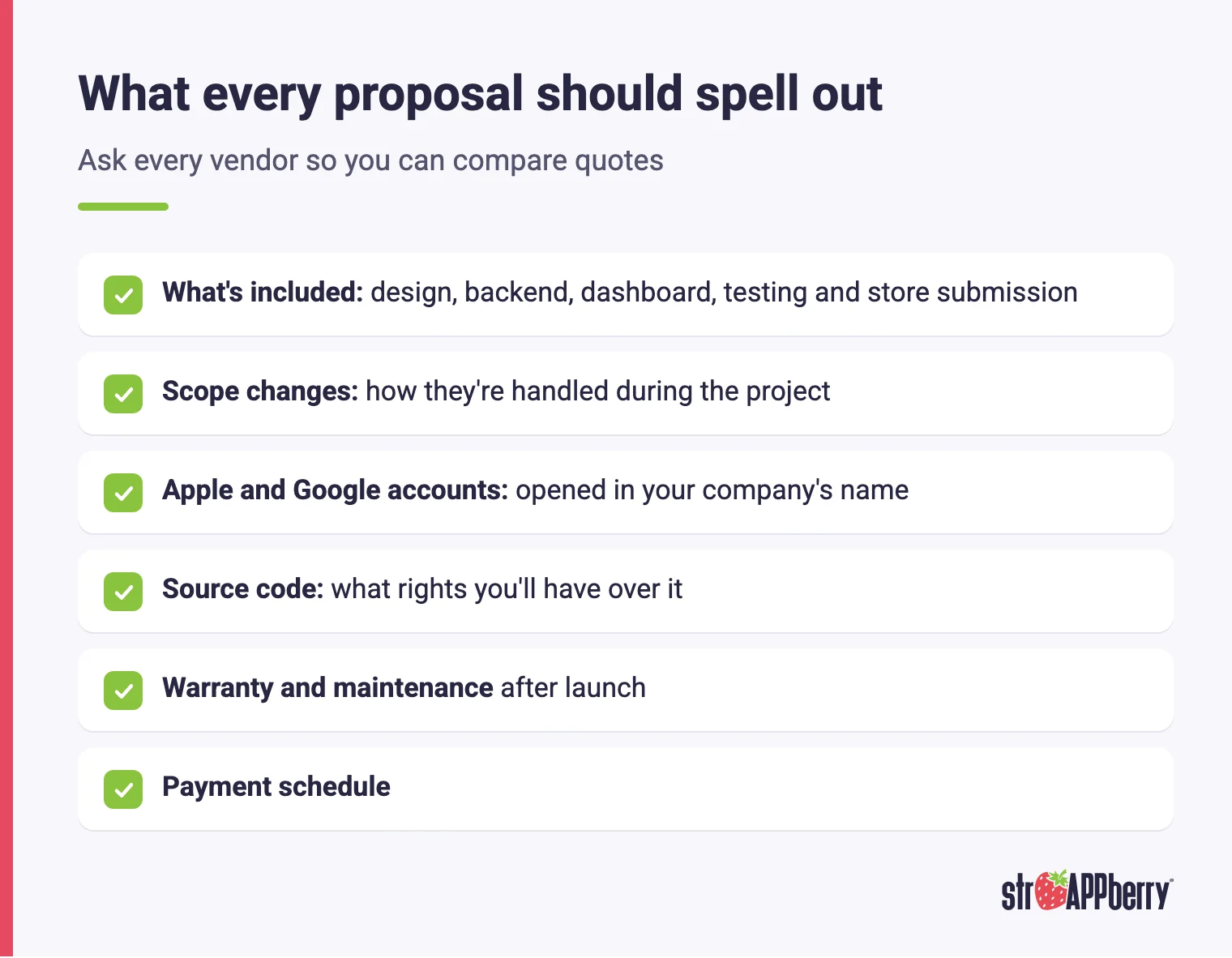
Then ask each proposal to spell out:
- what's included: design, backend, admin dashboard, testing and store submission;
- how scope changes are handled during the project;
- whose name the Apple and Google accounts are opened under (ideally your company's);
- what rights you'll have over the source code;
- the warranty and what maintenance looks like after launch;
- the payment schedule.
When the proposals come in, compare them line by line: they should cover the same scope, the same deliverables and the same level of support. Ask what post-launch support includes and what is billed separately. If one quote is much lower than the rest, check what it leaves out before deciding on price.
How does Strappberry put together a quote?
Our process has four steps: a discovery call, a walkthrough of real projects we've built, a proposal with pricing and, once you accept, the start of the work. We build the MVP in 2 months, we can work with monthly retainer payments or financing, and everything we deliver comes with a 1-year warranty backed by a contract. If you want to know what your app would cost, tell us about your project or explore our custom software development services.
